
So if you're shopping for a 2019 to 2025 RAV4, you'll see the RAV4 Hybrid and the RAV4 Prime. And at the same Toyota dealer, you'll see the fully electric bZ4X. However, the truth is that the names make these three sound a lot more alike than they are. So in this guide I'll explain what each one actually is, in plain words, and what each one costs to buy and to run. And I'll go over what's great and not so great about each one, to help you figure out which one makes sense for you.
Quick picks
What a hybrid, a plug-in hybrid and a fully electric car actually are
So the words hybrid, plug-in hybrid and fully electric get thrown around a lot, but they mean very different things. Here's what each word means on a 2019 to 2025 RAV4 or bZ4X, plus the regular gas RAV4 for comparison.
- A hybrid, like the RAV4 Hybrid, has a gas engine plus electric motors that help the engine. Basically, the RAV4 Hybrid charges its own small battery from the engine and from slowing down, so you never plug the RAV4 Hybrid in. You just fill up with gas like any other car, and the RAV4 Hybrid's small battery never runs out.
- A plug-in hybrid, like the RAV4 Prime, is a hybrid with a much bigger battery that you charge by plugging into an outlet. The RAV4 Prime drives on electricity first, for about 42 miles. Then once the big battery is used up, the RAV4 Prime keeps going on gas and works like a regular hybrid. Toyota sold the RAV4 Prime from 2021 to 2025, and for 2025 Toyota renamed the RAV4 Prime the "RAV4 Plug-in Hybrid."
- A fully electric car, like the Toyota bZ4X, has no gas engine and no gas tank at all. Plugging in is the only way to "fuel" a bZ4X, and when the bZ4X's battery is empty, the bZ4X stops until you charge it. Toyota sold the bZ4X as a 2023 to 2025 model.
- The regular gas RAV4 runs on gas only, with just a normal 12-volt car battery for starting the car and running the electronics.
The RAV4 Prime's driving modes
Now the RAV4 Prime has a few driving modes that the RAV4 Hybrid doesn't. Basically, these modes let you choose when the RAV4 Prime uses its battery and when it uses gas.
- EV mode, short for electric vehicle mode, drives on the battery only, with the engine off.
- HV mode, short for hybrid vehicle mode, drives like a regular hybrid and saves the battery's charge for later.
- Auto EV/HV mode lets the RAV4 Prime switch between EV mode and HV mode on its own.
- Charge mode uses the engine to recharge the battery while you drive, so you can arrive with electric range. But keep in mind the RAV4 Prime's gas mileage drops a lot while Charge mode is running. One Oregon owner uses Charge mode on the freeway so he can drive forest roads quietly on electricity.
- Trail mode is for slippery or rough ground.
The 2019 to 2025 gas RAV4, RAV4 Hybrid, RAV4 Prime and bZ4X, side by side
So here's how the four compare on the things buyers ask about most. Prices are Toyota's suggested prices when new, before the delivery fee. And "MPGe" is the EPA's way of turning electricity use into a number you can compare with miles per gallon. AWD means all-wheel drive. And the onboard charger is the part inside the car that charges the battery from the plug. A kW, or kilowatt, measures charging power, so a 6.6 kW onboard charger fills the battery faster than a 3.3 kW one.
| What you're comparing | Gas RAV4 | RAV4 Hybrid | RAV4 Prime (plug-in hybrid) | bZ4X (fully electric) |
|---|---|---|---|---|
| Years sold | 2019 to 2025 | 2019 to 2025 | 2021 to 2025 | 2023 to 2025 |
| Price new, 2025 | $29,800 to $38,105 (front-wheel drive and AWD) | $32,850 to $41,155 | $44,815 to $48,685 | $37,070 (XLE FWD) to $41,800 (Limited FWD) |
| Plugs in? | No | No, never | Yes | Yes, and that's the only way to fuel it |
| EPA mileage, combined | 28 mpg AWD, 30 mpg front-wheel drive | 40 mpg AWD (2019 to 2023), 39 mpg AWD (2024 and 2025) | 94 MPGe on electricity, then 38 mpg on gas | 119 MPGe front-wheel drive, 104 MPGe AWD |
| Electric range (EPA) | None | None | 42 miles, then gas takes over (600 miles total) | 252 miles front-wheel drive, 228 miles AWD, 222 miles for the 2025 Limited and Nightshade AWD |
| Charging at home | Not needed | Not needed | About 12 hours on a regular wall outlet. On a 240-volt charger, 2.5 hours with the 6.6 kW onboard charger, or 4.5 hours with the 3.3 kW one on some 2021 and 2022 cars | About 9.5 hours on a 240-volt charger |
| Fast charging on the road | Not needed | Not needed | Not possible. The RAV4 Prime only takes the standard J1772 plug at home-style chargers | Yes, about 30 to 35 minutes from 10% to 80% in one 2025 review |
| Horsepower | 203 | 219 | 302 | Not listed here |
| 0 to 60 mph, magazine tests | 8.0 to 8.8 seconds | 7.1 to 7.8 seconds | 5.4 to 5.9 seconds | About 5.8 to 6.7 seconds (Limited) |
| Towing | 1,500 lb, or 3,500 lb on the Adventure and TRD Off-Road | 1,750 lb | 2,500 lb | 1,500 lb, per a 2023 review |
| Cargo behind the back seat | 37.5 to 37.6 cu ft | 37.5 cu ft | 33.5 cu ft | 27.7 cu ft |
| Weight | About 3,370 to 3,640 lb | About 3,690 to 3,800 lb | 4,235 to 4,300 lb | Not listed here |
| Battery warranty | No big battery | 8 years or 100,000 miles on a 2019, then 10 years or 150,000 miles from 2020 | 10 years or 150,000 miles | Toyota's own pages disagree, so check with a dealer |
| Reliability (Consumer Reports) | Above average in most years | Above average in every year | Above average in every year Consumer Reports lists | Weakest of the four for 2023 and 2024, much better for 2025 |
| Value lost over 5 years (iSeeCars) | Not compared | About 25% to 31% | About 35% | About 47% |
| Insurance, national average (The Zebra) | $143 a month | $164 a month | $196 a month | Not compared |
So something that surprises a lot of people is that on gas, the RAV4 Prime gets slightly worse mileage than the RAV4 Hybrid. The RAV4 Prime gets 38 mpg on gas, and the RAV4 Hybrid gets 39 to 40 mpg. Basically, the RAV4 Prime is about 500 pounds heavier because of its big battery. One RAV4 Prime owner also said the RAV4 Hybrid gets better gas mileage, after test driving a RAV4 Hybrid.
And keep in mind, the iSeeCars numbers for the bZ4X can't be a true 5-year figure yet, since the bZ4X first went on sale as a 2023 model. So I'd treat the resale row as a ranking, not exact numbers. The RAV4 Hybrid holds its value best, and for comparison, iSeeCars' 2026 study puts the average car at about 42% lost over five years.
What the gas RAV4, RAV4 Hybrid, RAV4 Prime and bZ4X cost to fuel or charge for a year
So here's roughly what each of the four costs to run for a year, using these numbers:
- 15,000 miles a year, at the EPA's combined ratings.
- Gas at $4.33 a gallon, AAA's national average on October 14, 2026.
- Home electricity at 18.31 cents per kWh, the U.S. average for July 2026 from the U.S. Energy Information Administration. A kWh, or kilowatt-hour, is the unit your power bill charges you for.
- Public charging at 42 cents per kWh, AAA's national average.
| Car and how it's driven | About this much a year |
|---|---|
| Gas RAV4 AWD (28 mpg) | $2,320 |
| Gas RAV4 front-wheel drive (30 mpg) | $2,165 |
| RAV4 Hybrid (39 mpg) | $1,665 |
| RAV4 Prime, never plugged in (38 mpg) | $1,710 |
| RAV4 Prime, half the miles on home electricity | $1,350 |
| RAV4 Prime, 70% of the miles on home electricity | $1,205 |
| bZ4X AWD, all home charging | $850 |
| bZ4X front-wheel drive, all home charging | $780 |
| bZ4X AWD, all public charging | $1,950 |
So the RAV4 Hybrid saves about $650 a year over the gas RAV4 AWD at these prices. And the EPA's own estimates on fueleconomy.gov land in the same order, with the bZ4X cheapest, then the RAV4 Prime, the RAV4 Hybrid and the gas RAV4.
Now here's the part a lot of people miss. A RAV4 Prime costs about 6.6 cents a mile on home power and about 11.4 cents a mile on gas. But on a paid public charger, the RAV4 Prime costs about 15.1 cents a mile. So charging a RAV4 Prime at a public charger costs more than just burning gas. And where home power is expensive, like the part of California served by the power company PG&E, even home charging can cost about as much as gas.
One RAV4 Prime owner in Sacramento tracked every gallon and kWh on his 2023 RAV4 Prime SE for 11 months. He drove 13,509 miles, about 4,111 of them on electricity, and worked out about 5.9 cents a mile in total. He figured a RAV4 Hybrid would have cost him about 9.6 cents a mile, and a gas RAV4 about 12.5 cents.
Does the RAV4 Prime pay for itself?
So for most people, no, not on fuel savings alone. At today's prices, the RAV4 Prime saves roughly $300 to $460 a year over the RAV4 Hybrid, if half to 70% of your miles are on home electricity.
But the RAV4 Prime costs a lot more to buy. The cheapest 2025 RAV4 Prime listed at $44,815, about $12,000 over the cheapest 2025 RAV4 Hybrid AWD at $32,850. But the RAV4 Prime and RAV4 Hybrid trims don't line up exactly. One RAV4 Prime owner priced a RAV4 Prime SE and a RAV4 Hybrid SE with similar packages in 2023, and the gap was about $8,000.
So with an $8,000 to $12,000 price gap and $300 to $460 a year in savings, paying back the difference takes decades, not years. And keep in mind that The Zebra's averages put RAV4 Prime insurance about $384 a year higher than the RAV4 Hybrid's. That alone can cancel out the fuel savings. The Sacramento owner I mentioned said the same thing: his RAV4 Prime saved a little money, but nowhere near enough to cover a $12,000 higher price.
So ultimately, the reasons to buy a RAV4 Prime are the power, the quiet electric driving and skipping the gas station on short days. If those matter to you and the RAV4 Prime fits your budget, the RAV4 Prime is a great car. But I wouldn't buy a RAV4 Prime just to save money on gas.
Tax credits for the RAV4 Prime and bZ4X
So right now there's no federal tax credit for any of these four. All federal credits for new and used electric cars ended for cars bought after September 30, 2025. Here's how the credits worked before that, since that history affects what used buyers see in listings and forums.
- 2021 to August 15, 2022: The RAV4 Prime qualified for the full $7,500 federal credit, because of its 18.1 kWh battery.
- From August 16, 2022: A new law, the Inflation Reduction Act, required final assembly in North America. The RAV4 Prime is built in Japan, so new RAV4 Prime buyers lost the credit from that date.
- Leasing, 2023 to September 2025: Leased cars counted as business vehicles. So the leasing company could claim $7,500 even on a Japan-built car, and pass some or all of that $7,500 to you as a lower lease price. This leasing route was used a lot on the bZ4X, and at least one RAV4 Prime buyer leased and then bought the RAV4 Prime out.
- The bZ4X never qualified for the purchase credit, because the bZ4X is also built in Japan.
- The RAV4 Hybrid and the gas RAV4 never qualified for any of these credits.
And the federal credit for installing a home charger, 30% up to $1,000, doesn't cover chargers put in service after June 30, 2026. Some states have their own credits, so it's worth checking your state before you buy.
Charging at home vs public charging
So how you'll charge is the biggest question for the RAV4 Prime and the bZ4X. Basically, there are three speeds of charging:
- Level 1 is a regular 120-volt wall outlet, the same kind you plug a lamp into. Level 1 is slow but needs nothing extra.
- Level 2 is a 240-volt charger, the kind of outlet a clothes dryer uses. Most people with an electric car get a Level 2 charger installed at home.
- DC fast charging is the big public charger you find at highway stops. A DC fast charger charges much faster than Level 1 or Level 2.
Charging a RAV4 Prime
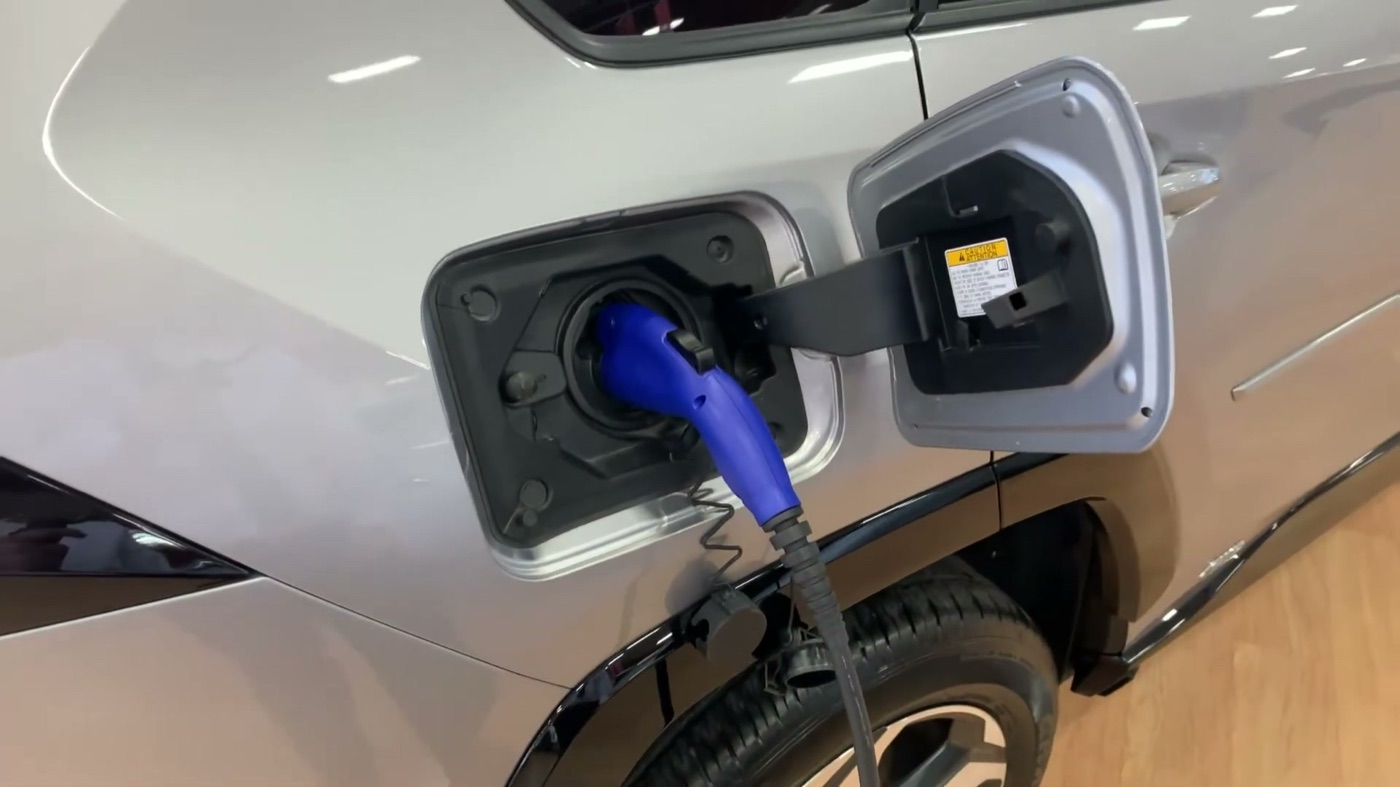
Here's a 2021 RAV4 Prime plugged in with the charging cable Toyota includes, and the RAV4 Prime's charge port sits behind its own little door on the rear passenger side, from Johnathan Steblaj's video.
So for a RAV4 Prime, a regular wall outlet is enough for most people. A full charge takes about 12 hours, so plugging in overnight basically does the job. A Level 2 charger cuts a full charge to 2.5 hours, or 4.5 hours on a car with the slower 3.3 kW onboard charger.
And something to note is which onboard charger a used RAV4 Prime has. The 2021 RAV4 Prime SE came with the slower 3.3 kW charger, and the faster 6.6 kW charger came with the 2021 XSE Premium Package. On the 2022, the 6.6 kW charger was an $800 option. And from 2023 on, every RAV4 Prime has the 6.6 kW charger.
The RAV4 Prime can't use DC fast chargers at all. So on a road trip, you just drive the RAV4 Prime on gas like a hybrid.
Charging a bZ4X
Now for a bZ4X, a Level 2 charger at home is close to a must. A Level 2 charger takes the bZ4X from its low-battery light to full in about 9.5 hours. A regular outlet would be much slower than that on a battery as big as the bZ4X's.
A home Level 2 install runs roughly $900 to $2,500 for most homes, and more if your electrical panel needs an upgrade. Those numbers are estimates from cost guides, so a local electrician's quote is what really counts.
The bZ4X can use DC fast chargers on a road trip. One 2025 review timed a fast charge from 10% to 80% battery at about 30 to 35 minutes. But Toyota's early specs said the AWD bZ4X takes about an hour to reach 80%. And a lot of owners say the bZ4X's fast charging is slow, especially in the cold. New 2025 bZ4X buyers did get one year of free public charging at EVgo stations.
How the RAV4 Hybrid, RAV4 Prime and bZ4X do in winter
So winter is where these three really differ, because each one heats the cabin in a different way.
- The RAV4 Hybrid heats the cabin with heat from the engine. So in the cold, the RAV4 Hybrid behaves a lot like a gas car, just with lower mileage than in summer.
- The RAV4 Prime has a heat pump, which is basically an efficient electric heater. So the RAV4 Prime can heat the cabin on battery alone, down to a certain outside temperature. Below that temperature, the engine starts on its own to make heat, even with a full battery. Owners put that temperature somewhere in the teens to mid-20s °F. And the heat pump fades out gradually rather than switching off at one exact temperature.
- The bZ4X also has a heat pump, but the bZ4X has no engine to fall back on. So all the heat comes out of the battery, and the bZ4X loses a lot of range in winter.
How much electric range the RAV4 Prime loses in winter
So RAV4 Prime owners report a big drop in electric range in the cold, especially on the highway. These are some real numbers from owners and testers:
- A Wisconsin owner gets 42 miles at 50°F and 34 miles below zero. He has to use the engine for cabin heat below about 20°F.
- A 2023 RAV4 Prime XSE owner gets about 50 miles around town in spring and fall. But that range can drop to about 20 miles on the highway on a very cold winter day.
- Cars.com drove a RAV4 Prime at 37°F, mostly on the highway, and got about 30 electric miles.
- A Canadian owner gets 43 to 50 miles in summer and 34 to 37 miles in snow.
But the good news is that the RAV4 Prime still works fine in the cold, because the RAV4 Prime just switches to gas. One owner in the Canadian cold found that running the engine for heat in EV mode still used less gas than plain hybrid mode. And owners recommend using the heated seats and heated steering wheel, and warming the RAV4 Prime up while it's still plugged in. Those owners also use EV mode in town and HV mode on the highway.
How much range the bZ4X loses in winter
So I couldn't find a U.S. winter range test for the bZ4X, but European tests point to a big loss. A Danish test at about 39°F got roughly half the European rated range. And keep in mind that European ratings run higher than the EPA's, so compared with the U.S. rating, the bZ4X would lose less than half its range. In the U.S., Edmunds' real-world test of a 2023 bZ4X Limited front-wheel drive came in at 227 miles, 15 miles short of the EPA rating for that bZ4X.
And something to note is that Toyota originally said the AWD bZ4X's fast charging may slow down below 32°F and may not work around -4°F. But Toyota later reworded that warning.
Pros and cons of the gas RAV4, RAV4 Hybrid, RAV4 Prime and bZ4X
RAV4 Hybrid: pros and cons
What's great about the RAV4 Hybrid:
- The RAV4 Hybrid never needs plugging in, so the RAV4 Hybrid works for anyone, including apartment renters and people who park on the street.
- The RAV4 Hybrid gets the best gas mileage of the RAV4s that burn gas, at 39 to 40 mpg combined.
- The RAV4 Hybrid holds its value best of the three that use electric power, and the RAV4 Hybrid costs less to insure than the RAV4 Prime.
- Consumer Reports rates the RAV4 Hybrid's reliability above average in every year from 2019 to 2025.
- The RAV4 Hybrid keeps the full 37.5 cubic feet of cargo space behind the back seat.
What's not so great about the RAV4 Hybrid:
- The RAV4 Hybrid can't drive any real distance on electricity alone, so every mile uses some gas.
- The RAV4 Hybrid tows only 1,750 pounds.
- On 2019 to 2022 RAV4 Hybrids, the high-voltage cable to the rear motor can corrode, which owners call "cablegate." Toyota extended the warranty coverage on that cable, so a Toyota dealer fixes the cable for free while that extended coverage lasts.
RAV4 Prime: pros and cons
What's great about the RAV4 Prime:
- The RAV4 Prime drives about 42 miles on electricity, so short daily drives can run on electricity alone.
- The RAV4 Prime still has a gas engine, so long trips work just like in a RAV4 Hybrid, with about 600 miles of total range.
- With 302 horsepower and 0 to 60 mph in about 5.4 to 5.9 seconds in magazine tests, the RAV4 Prime is the quickest 2019 to 2025 RAV4.
- The RAV4 Prime tows 2,500 pounds, more than the RAV4 Hybrid.
- The RAV4 Prime's big battery sits under the floor, and one owner says that makes the RAV4 Prime feel very stable on twisty roads.
- The 2021 RAV4 Prime XSE with the Premium Package has a 1,500-watt, 120-volt outlet in the cargo area. One camper runs a small space heater from that outlet, and keeps the air conditioning running all night while plugged in.
- Consumer Reports rates the RAV4 Prime's reliability above average in every year it lists. And one owner's RAV4 Prime still had over 40 miles of electric range at about 110,000 miles.
What's not so great about the RAV4 Prime:
- The RAV4 Prime costs about $8,000 to $12,000 more than a similar RAV4 Hybrid, and the fuel savings don't pay back that difference.
- The RAV4 Prime can't use DC fast chargers, and charging at a paid public charger costs more than gas.
- On gas, the RAV4 Prime gets 38 mpg, slightly worse than the RAV4 Hybrid.
- The RAV4 Prime has 33.5 cubic feet of cargo space behind the back seat. That's about 4 cubic feet less than the RAV4 Hybrid, because of the big battery under the floor.
- The RAV4 Prime costs more to insure, and one owner says the RAV4 Prime's tires wear faster because of the extra weight.
- In very cold weather, the RAV4 Prime's engine runs for cabin heat, even with a full battery.
bZ4X: pros and cons
What's great about the bZ4X:
- The bZ4X is the cheapest of the four to run if you charge at home. That's about $780 to $850 a year in electricity at the prices above.
- The bZ4X uses no gas at all and never needs an oil change.
- The bZ4X can use DC fast chargers on a road trip, which the RAV4 Prime can't.
- Toyota cut the 2025 bZ4X's price a lot, to $37,070 for the XLE front-wheel drive, which is less than any 2025 RAV4 Prime.
- Consumer Reports rates the 2025 bZ4X's reliability much better than the 2023 and 2024 bZ4X.
What's not so great about the bZ4X:
- The bZ4X has the shortest range of the four, at 222 to 252 miles rated, and much less in winter.
- Owners say the bZ4X's fast charging is slow, especially in the cold.
- The bZ4X has the smallest cargo area of the four, at 27.7 cubic feet behind the back seat.
- The bZ4X loses value the fastest, at about 47% over five years by iSeeCars' estimate.
- The bZ4X had a 2022 recall where the wheels could come loose. Toyota fixed the wheel problem in October 2022. But it's worth checking any used bZ4X by its VIN, the vehicle identification number.
Gas RAV4: pros and cons
What's great about the gas RAV4:
- The gas RAV4 has the lowest price of the four.
- The gas RAV4 Adventure and TRD Off-Road are the only ones here that tow 3,500 pounds.
- The gas RAV4 sits a little higher, at 8.4 to 8.6 inches of ground clearance, against 8.0 to 8.2 inches on the RAV4 Hybrid and RAV4 Prime. Ground clearance is the gap between the ground and the lowest part of the car.
What's not so great about the gas RAV4:
- The gas RAV4 costs the most to fuel, at about $650 a year more than the RAV4 Hybrid at today's prices.
- The gas RAV4 is the slowest of the four, at about 8.0 to 8.8 seconds from 0 to 60 mph.
Who should pick the RAV4 Hybrid, RAV4 Prime, bZ4X or gas RAV4
So the choice really comes down to where you'll charge and how far you drive each day. These are the situations where each one makes the most sense.
- Pick the RAV4 Hybrid if you can't charge at home, or if you drive a lot of highway miles. The RAV4 Hybrid is also the pick if you want the most value, with better resale and lower insurance than the RAV4 Prime. And for most people, the RAV4 Hybrid is the default choice.
- Pick the RAV4 Prime if you can charge at home at normal power prices and most days are under about 30 to 40 miles. The RAV4 Prime fits best if you also want its power or quiet electric driving. But if you're in a place with expensive power, like the PG&E area of California, or a very cold place, the RAV4 Prime's advantage shrinks a lot.
- Pick the bZ4X if you can install a Level 2 charger at home, you mostly drive locally, and you have another car for long trips.
- Pick the gas RAV4 if you want the lowest price, or you need to tow up to 3,500 pounds with an Adventure or TRD Off-Road.
And for car campers, the 1,500-watt outlet on a RAV4 Prime XSE with the Premium Package and the air conditioning that can run all night while plugged in are real perks. But the RAV4 Prime has less cargo height, and one RAV4 Prime camper wished the cargo area were taller to sit up in. The RAV4 Hybrid shuts itself off after about an hour in Park, and Toyota says to turn the RAV4 Hybrid off before sleeping in it. I cover sleeping in a RAV4 more in my cold-weather car camping guide.
Tips for buying a used RAV4 Hybrid, RAV4 Prime or bZ4X
Listing sites often call a RAV4 Prime a "RAV4 Hybrid SE"
So this is something to watch for. Car listing sites like AutoTrader, CarMax and Carvana often file the RAV4 Prime under "RAV4 Hybrid" with the trim "SE." So from the listing alone, you can't tell a RAV4 Prime from a RAV4 Hybrid SE. And the price difference between a RAV4 Prime and a RAV4 Hybrid SE is big.
The VIN, or vehicle identification number, is what tells a RAV4 Prime and a RAV4 Hybrid SE apart. These are the ways to check:
- Read the start of the VIN. A RAV4 Hybrid SE's VIN starts with 4T3T6RFV, 2T3T6RFV or JTM16RFV. A RAV4 Prime SE's VIN contains B3FV, for example JTMAB3FV, JTMCB3FV or JTMEB3FV.
- Run the VIN through NHTSA's free VIN decoder. NHTSA is the U.S. government's vehicle safety agency. Look for the line called "Electrification Level." A RAV4 Hybrid shows "Strong HEV," short for hybrid electric vehicle. And a RAV4 Prime shows "PHEV," short for plug-in hybrid electric vehicle.
- Check the Carfax report. A RAV4 Prime's Carfax report often says "PLUG-IN HYBRID" in the title.
What to check on each used model
- 2019 and 2020 RAV4 Hybrid: On some cars, the gas tank only takes 9 to 10 of its 14.5 gallons. Toyota ran a customer support program with a replacement tank, so ask the seller or a Toyota dealer whether that car's tank was replaced.
- 2019 to 2022 RAV4 Hybrid: Ask a dealer whether the "cablegate" cable repair has been done. Toyota's U.S. extended coverage program for that cable, number 22TE09, runs 8 years. If the corrosion is ignored, the RAV4 Hybrid may not start.
- 2023 and 2024 RAV4 Hybrid and RAV4 Prime: Toyota Canada later sealed the same connector and extended the coverage to 10 years with unlimited miles on 2023 and 2024 cars. If you're in the U.S., ask a Toyota dealer whether that applies to your car.
- 2021 RAV4 Prime: Recall 23V-041 fixed a problem where flooring the gas pedal after driving in EV mode in the cold could shut the hybrid system down. The fix is a free software update.
- 2021 and 2022 RAV4 Prime: Recall 23V-478 replaces a part called the DC-DC converter, which could short and overheat. Until the DC-DC converter is replaced, Toyota told owners not to charge at or below about 41°F. Toyota dealers replace the DC-DC converter for free.
- 2021 and 2022 RAV4 Prime: Check whether the RAV4 Prime has the 3.3 kW or the 6.6 kW onboard charger. The 3.3 kW charger takes 4.5 hours on Level 2 instead of 2.5.
- Any used RAV4 Prime: Charge the battery full and look at the range shown. One owner with a healthy 3-year-old RAV4 Prime sees 38 to 43 miles on a full charge. And a Toyota dealer can also check the battery's health.
- 2023 bZ4X: Check the VIN for the 2022 wheel bolt recall.
And for any used RAV4 or bZ4X, you can look up open recalls by VIN on NHTSA's recall lookup. Basically, a recall repair is free at any Toyota dealer.
Maintenance differences worth knowing
- Brakes last a long time on the RAV4 Hybrid and RAV4 Prime, because the electric motor does a lot of the slowing down. One RAV4 Prime owner first replaced his rear brakes at 133,000 miles, for about $375 at the dealer, and his front brakes were only half worn.
- The RAV4 Prime's air conditioning needs its refrigerant discharged and recharged every 80,000 miles, according to The Car Care Nut, because the heat pump also cools the battery. I haven't confirmed that against Toyota's maintenance guide, so it's worth asking a dealer.
- All four come with a 3-year or 36,000-mile basic warranty, a 5-year or 60,000-mile powertrain warranty, and ToyotaCare, Toyota's free scheduled maintenance plan, for 2 years or 25,000 miles.
- Replacing the hybrid battery after the warranty runs about $3,000 to $8,000 for a RAV4 Hybrid, depending on the source. One owner guessed about $10,500 for a RAV4 Prime battery, but that's an estimate, not a quote.
Shopping for a 2026 RAV4?
So the 2026 RAV4 is a new generation. Toyota renamed the bZ4X the "bZ" for 2026, and the 2026 RAV4 Plug-in Hybrid dropped Charge mode. I compare the 2026 models in my 2026 RAV4 Hybrid vs Plug-in Hybrid vs electric bZ guide.
Videos worth watching about the RAV4 Hybrid and RAV4 Prime
And if you want to hear from people who own a RAV4 Hybrid or RAV4 Prime, here are the clearest videos I found. You can play each video right here on the page, and YouTube's usual controls work, including skipping ahead, changing the speed and going full screen. And under each video, I've put a quick summary of what the video covers, so you can decide whether it's worth your time.
A RAV4 Prime owner explains when the RAV4 Hybrid is the smarter buy.
- The price gap: He priced a RAV4 Prime SE at $45,340 and a RAV4 Hybrid SE with similar packages at $37,335, about $8,000 apart.
- Gas mileage: He says the RAV4 Hybrid gets better gas mileage than the RAV4 Prime in hybrid mode, which matters on long trips.
- Charging: He points out that the RAV4 Hybrid never needs charging, and that electricity can cost more than gas in some states.
- How the RAV4 Hybrid drives: On a test drive, he found the RAV4 Hybrid lighter and nimbler, plenty quick on the freeway, but noisier when you accelerate hard.
A Toyota mechanic goes through how the RAV4 Prime is built and what tends to go wrong.
- The battery: He shows that the RAV4 Prime's big battery sits under the cabin floor, not under the back seat like the RAV4 Hybrid's.
- The heat pump: He explains the heat pump and says the RAV4 Prime is fine in winters like Chicago's most of the time, but colder places are a problem.
- Known problems: He covers a heat pump buzz on early 2021 cars, which a software update fixed. He also covers a grounding problem with the converter on early cars that set off warning lights.
- Maintenance: He says the RAV4 Prime's A/C needs its refrigerant discharged and recharged every 80,000 miles, and that Charge mode drops the gas mileage a lot.
- The spare tire: He shows that the RAV4 Prime still has a fairly large temporary spare.
An Oregon owner talks about 133,000 miles in his RAV4 Prime, including a lot of camping.
- Battery health: In a range test at about 110,000 miles, his RAV4 Prime still went over 40 miles on battery alone.
- Repairs: He first replaced the rear brakes at 133,000 miles, for about $375, and the liftgate struts, which hold the rear hatch up, failed twice. The dealer wanted $1,200 for the struts, so he used cheap aftermarket ones.
- Tires: He got about 40,000 miles from the original tires.
- Camping: He runs a small space heater from the cargo outlet and keeps the air conditioning running all night while plugged in. He does wish the cargo area were taller to sit up in.
- Snow and Charge mode: He drives over the mountain pass to Sisters, Oregon, in snow, and uses Charge mode on the freeway to save battery for quiet forest roads.
An owner looks back on three years with his family's RAV4 Prime.
- Reliability: He says the RAV4 Prime needed no unscheduled repairs in three years.
- Battery health: His Toyota dealer checked the RAV4 Prime's battery before the 3-year mark and found no meaningful wear.
- Range: He says the trip computer shows 38 to 43 miles when the battery is full.
A Canadian owner compares his RAV4 Prime SE in summer and in snow.
- Electric range: He gets about 43 to 50 miles in summer and 34 to 37 miles in winter.
- The heat pump: He says the heat pump stops keeping up around 14°F, and then the engine runs for heat.
- The charge port: He says the RAV4 Prime's charge port door isn't sealed, and owners report the charge port door freezing, so he charges in a heated garage.
The same owner drives his RAV4 Prime at about 0°F to -18°F.
- Range in deep cold: He says you get about 31 to 37 miles of electric range in that cold, if you're lucky.
- The engine and heat: The engine started the moment he turned on the heat in EV mode.
- Gas use: Even with the engine running for heat, EV mode used less gas than plain hybrid mode in his test.
Buddy's take
So ultimately, for most people shopping for a 2019 to 2025 model, I'd recommend the RAV4 Hybrid. I drive a 2025 RAV4 Hybrid XSE myself, and the RAV4 Hybrid never needs a plug, gets about 39 to 40 mpg, and holds its value best.
But if you can charge at home at normal power prices and most of your days are short, the RAV4 Prime is a really nice upgrade. And the RAV4 Prime is the quickest 2019 to 2025 RAV4. Just buy the RAV4 Prime for the power and the quiet electric driving, not to save money on gas.
And the bZ4X makes sense if you can charge at home, mostly drive locally and have another car for long trips. But otherwise, the RAV4 Hybrid would be the one to get.
So hopefully this helps you figure out which of these four fits the way you drive.
Have a question about “RAV4 Hybrid vs RAV4 Prime vs bZ4X: which one makes sense for you (2019 to 2025)”?
Ask it here. Every question comes to me first. I'll answer as many as I can, and when I answer one, I'll add the question and my answer to this page so other RAV4 owners can see it too. I don't ask for your email, so check back on this page for the answer.
More buying guides
2026 RAV4 Hybrid vs RAV4 Plug-in Hybrid vs the electric Toyota bZ
I compare the prices, mileage, charging, running costs, towing, cargo and reliability of the 2026 RAV4 Hybrid, the 2026 RAV4 Plug-in Hybrid and the fully electric Toyota bZ. And I lay out the pros and cons of each one so you can pick.
2026 RAV4 technology features, explained
Toyota dropped the Technology Package on the 2026. Here's where each feature went, trim by trim.
The RAV4 Technology Package, explained
What the Technology Package adds on every 2019 to 2025 trim, what it costs, how each feature works in real life, and which XSE gets the 12.3-inch gauge screen.
Every RAV4 Hybrid trim, compared
Here's every RAV4 Hybrid trim from the LE to the Limited, year by year. And it shows what's standard and what you'd pay extra for.
The 2026 RAV4 Weather Package, explained
Which 2026 trims offer the Weather Package, what the 2026 Weather Package costs, and how the 2026 heated seats and wheel work.
The RAV4 Weather Package, explained
What the Weather Package adds on every 2019 to 2025 trim, what it costs, how each feature works in real life, and who should get it.
- Toyota's RAV4 spec books (SourceBooks): 2020 RAV4, 2023 RAV4, 2025 RAV4, 2021 RAV4 Prime, 2022 RAV4 Prime, 2023 RAV4 Prime, 2024 RAV4 Prime and 2025 RAV4 Plug-in Hybrid: horsepower, towing, cargo, weight, ground clearance, charging times, onboard chargers, driving modes and warranties. The 2019 battery warranty is from Toyota's 2019 RAV4 brochure.
- Toyota's press releases: 2021 RAV4 Prime launch pricing, 2025 bZ4X pricing, range, charging and cargo, and the 2026 bZ.
- EPA ratings and prices from fueleconomy.gov: 2019, 2021, 2023, 2024, 2025, and the 2023 bZ4X front-wheel drive. Federal tax credit rules from fueleconomy.gov, the IRS Form 8911 instructions and the Alternative Fuels Data Center.
- Prices used for yearly costs, read October 14, 2026: AAA gas and public charging averages and EIA home electricity prices. Home charger install costs from Recharged (Recharged has since removed that article) and HomeAdvisor.
- Reliability from Consumer Reports' RAV4, RAV4 Hybrid, RAV4 Prime and bZ4X pages, read October 14, 2026. Resale from iSeeCars (RAV4 Prime vs bZ4X, bZ4X vs RAV4 Hybrid). Insurance from The Zebra. 0 to 60 times from 0-60specs (RAV4) and 0-60specs (bZ4X). bZ4X towing from The Auto Channel, and charging and battery size from Recharged's 2025 bZ4X review (Recharged has since removed that article) and GreenCars.
- Recalls and service programs: NHTSA recalls 23V-041 and 23V-478, Guide Auto on the RAV4 Hybrid cable coverage and Toyota Canada's 2023 and 2024 extension, Green Car Reports on the 2019 and 2020 RAV4 Hybrid gas tank, and TFLcar on the bZ4X wheel recall and its fix. Battery replacement costs from SlashGear.
- Winter range and cold weather: Cars.com's cold test, Edmunds' bZ4X range test, the Danish cold test via Electrive, the ÖAMTC 2025 winter test, and Guide Auto on bZ4X cold fast charging.
- Owner experiences from RAV4World (11 months of RAV4 Prime costs, RAV4 Prime vs regular Hybrid), the InsideEVs Forum (winter range, cold weather), Engine Patrol, and owner mileage on Fuelly, read October 2026.
- The VIN details for telling a RAV4 Prime from a RAV4 Hybrid SE come from decoding listed cars with NHTSA's VIN decoder.
RAV Buddy is an independent fan site. We're not affiliated with or endorsed by Toyota. RAV4 is a trademark of Toyota Motor Corporation.