
If you live up high or drive mountain passes a lot, you might be wondering which RAV4 handles thin air better. Basically, both RAV4 engines lose power as the air gets thinner, but the RAV4 Hybrid's electric motors don't. In this guide I'll go through how much power each RAV4 loses, and what to do on long climbs and descents.
Why a RAV4 loses power at high altitude
So an engine makes power by burning fuel with air. Up high, the air is thinner, so each breath the engine takes holds less oxygen. And with less oxygen, the engine can only burn so much fuel, so the engine makes less power.
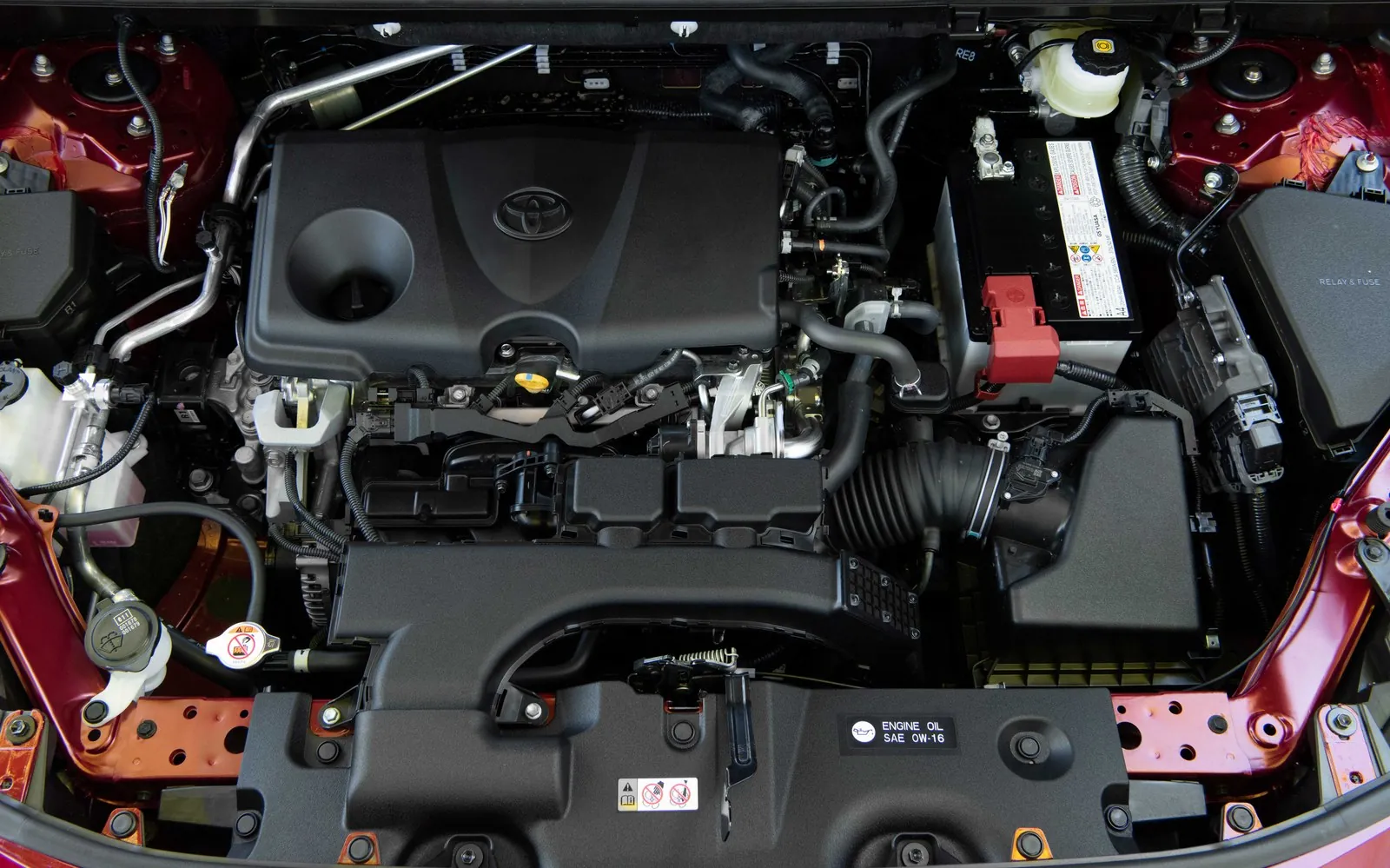
The 2.5-liter engine under the hood of a 2019 gas RAV4 Adventure, from Toyota's 2019 RAV4 press photos.
Basically, an engine without a turbo just breathes whatever air is around the engine. That kind of engine is called naturally aspirated. And a naturally aspirated engine loses about 3 percent of its power for every 1,000 feet you climb.
Both RAV4 engines, the gas RAV4's 2.5-liter and the RAV4 Hybrid's 2.5-liter, are naturally aspirated. So both RAV4 engines lose power as you climb.
Now a turbo engine works differently, because the turbo is a part that packs extra air into the engine. For example, the 2023 Audi Q5 I owned had a turbo 2.0-liter. And Garrett Motion, a company that makes turbos, says a turbo lets an engine make power "as if it was at sea level."
So the way I see it, the RAV4 Hybrid's electric push up high is the closest thing a RAV4 has to that turbo advantage.
How much power the gas RAV4 and RAV4 Hybrid have at Bend, Denver and 9,000 feet
So here's my own rough estimate of each RAV4's power at a few elevations, worked out from air pressure and the 3 percent rule. Keep in mind these are estimates, not measured numbers. No measured altitude test of either RAV4 has been published.
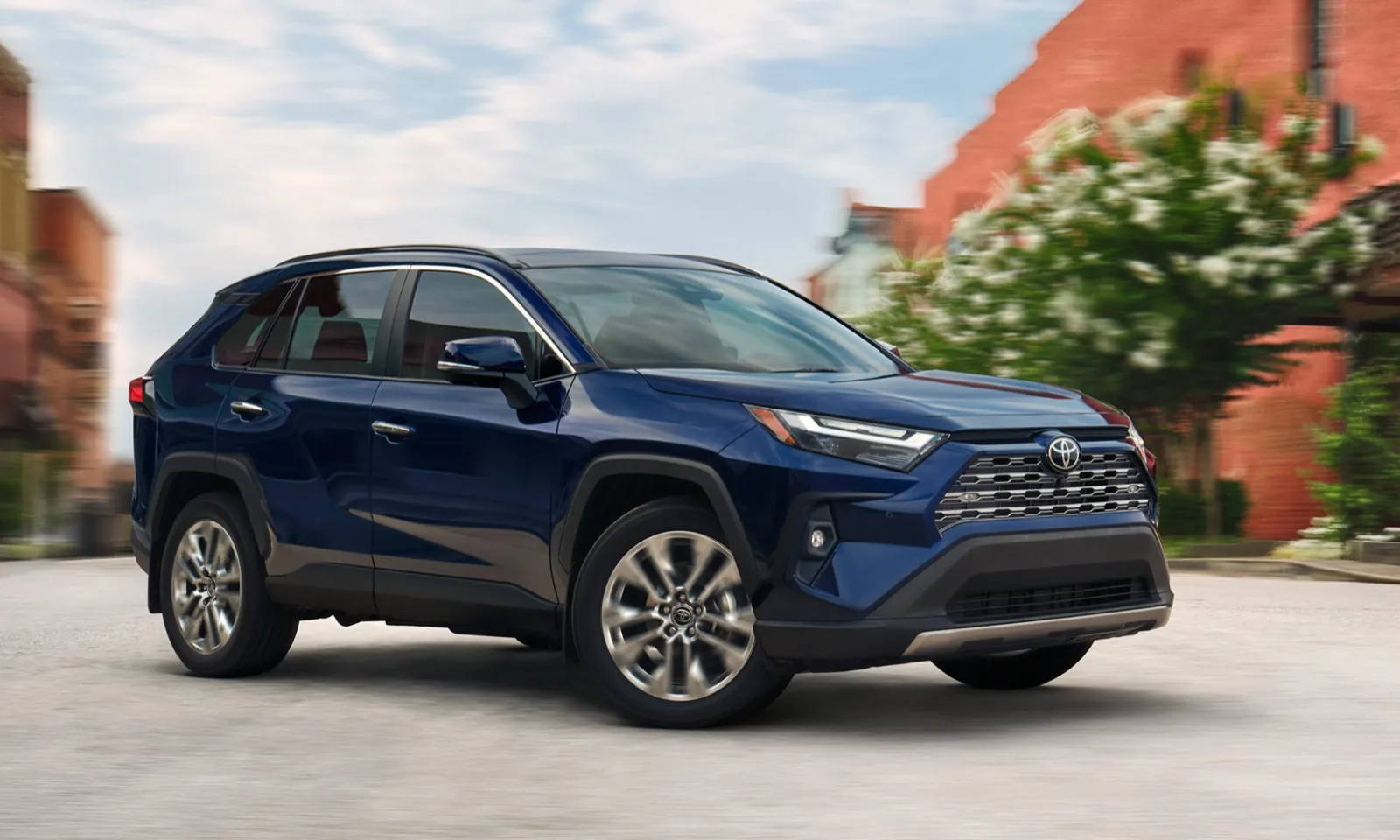
A 2025 RAV4 Limited in Blueprint, from Toyota's 2025 RAV4 press photos.
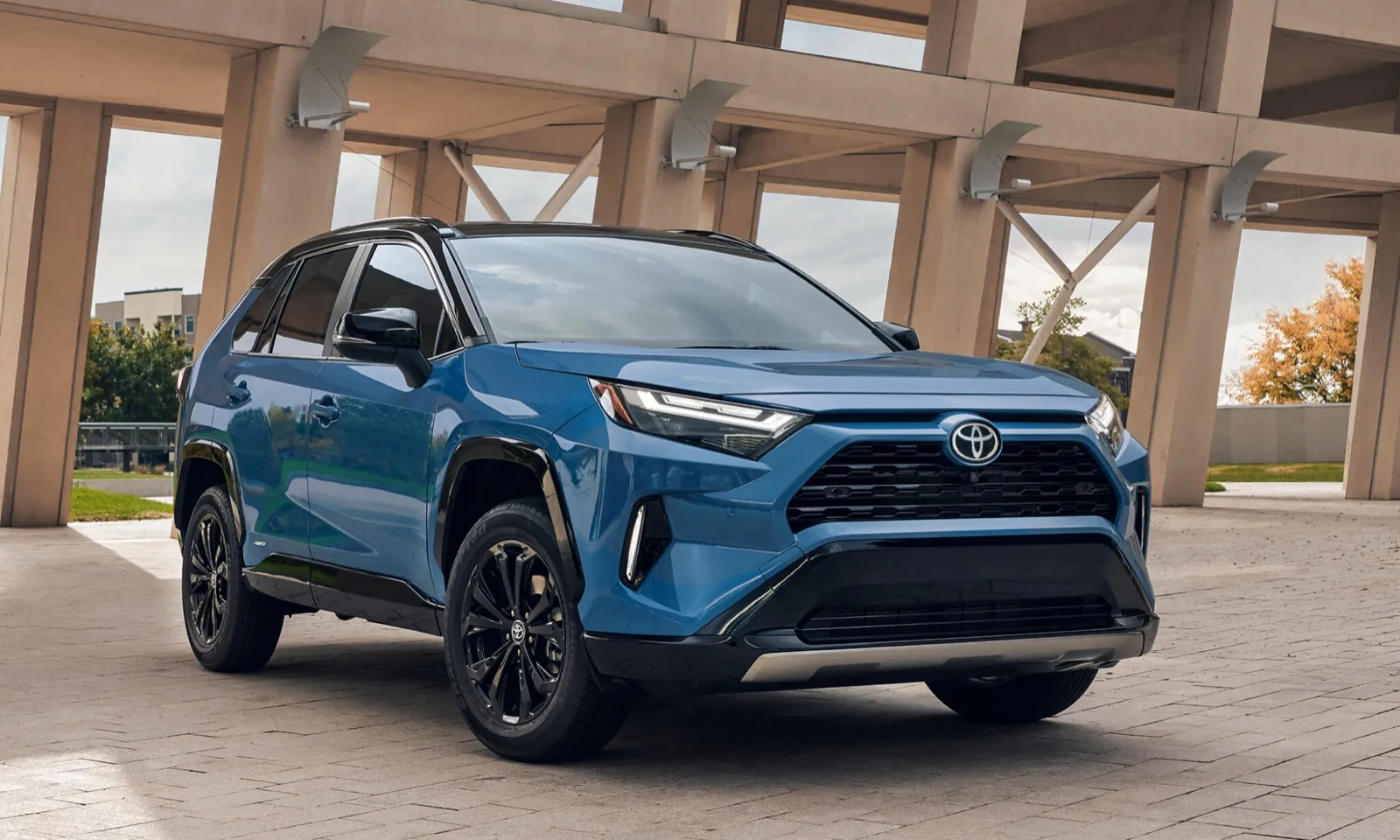
A 2025 RAV4 Hybrid XSE in Cavalry Blue, from Toyota's 2025 RAV4 press photos.
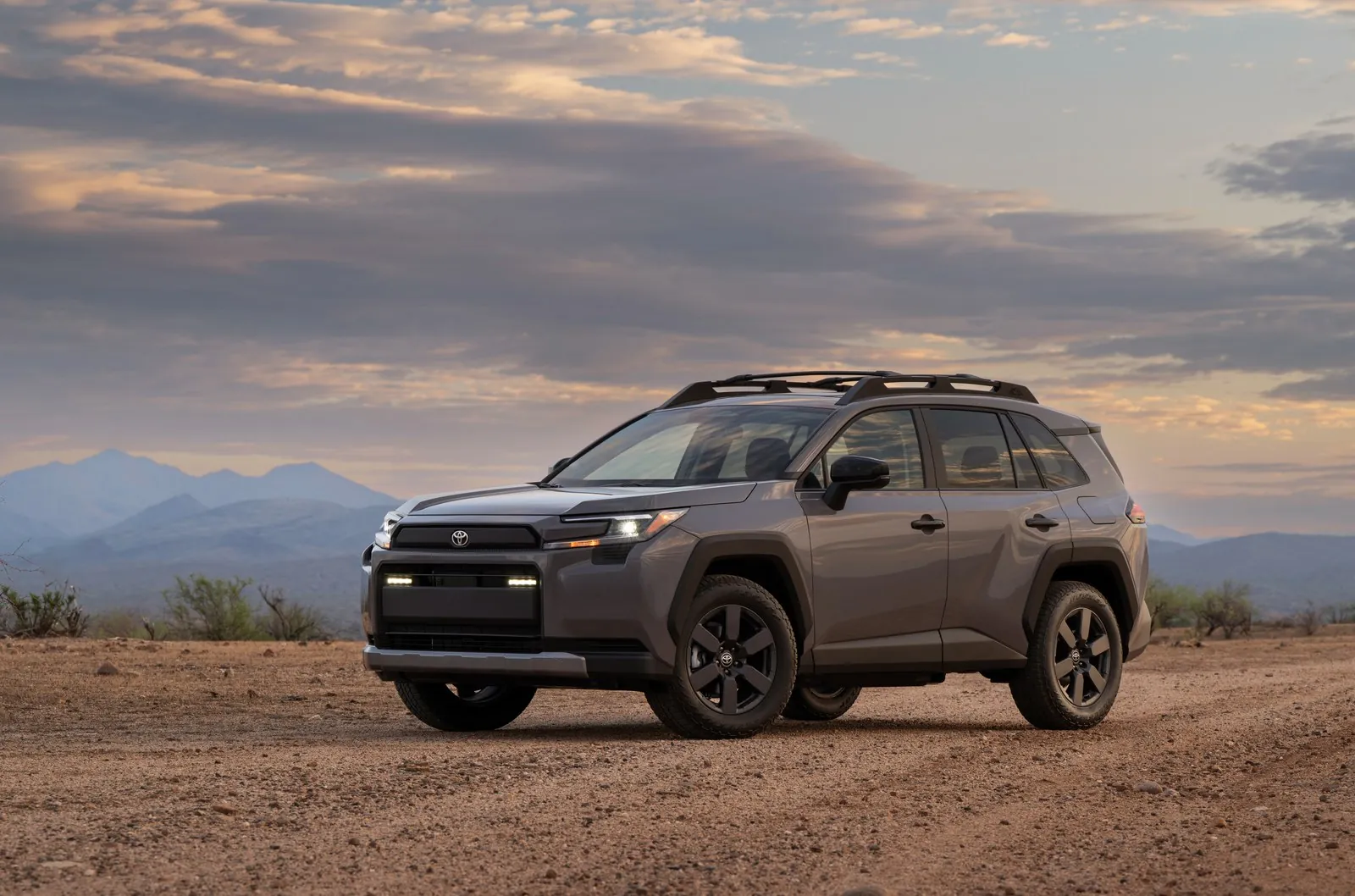
A 2026 RAV4 Hybrid Woodland in Urban Rock, from Toyota's 2026 RAV4 press photos.
| Elevation | Air pressure compared with sea level | Gas RAV4 (203 horsepower at sea level) | RAV4 Hybrid's engine on its own (176 horsepower at sea level) | RAV4 Hybrid combined (219 horsepower at sea level) |
|---|---|---|---|---|
| Sea level | 100 percent | 203 horsepower | 176 horsepower | 219 horsepower |
| Bend, Oregon (about 3,600 feet) | About 88 percent | About 178 to 181 horsepower | About 154 to 157 horsepower | About 197 to 200 horsepower |
| Denver (about 5,300 feet) | About 82 percent | About 167 to 171 horsepower | About 145 to 148 horsepower | About 188 to 191 horsepower |
| About 9,000 feet | About 72 percent | About 145 to 148 horsepower | About 126 to 128 horsepower | About 169 to 171 horsepower |
Now the reason the RAV4 Hybrid loses less is that only the RAV4 Hybrid's engine loses power. The electric motors run on the hybrid battery, and they don't need air.
So by my rough math, the gas RAV4 makes about 11 to 12 percent less power at Bend. The RAV4 Hybrid makes about 9 to 10 percent less. In Denver, that's about 16 to 18 percent for the gas RAV4 and 13 to 14 percent for the RAV4 Hybrid.
And at 9,000 feet, the loss is about 27 to 29 percent for the gas RAV4, and 22 to 23 percent for the RAV4 Hybrid.
Keep in mind the RAV4 Hybrid's combined numbers are the roughest ones in the table. Toyota doesn't publish how the RAV4 Hybrid's 219 horsepower splits between the engine and the motors. So my rough math just takes the engine's loss away from 219.
And the RAV4 Hybrid only gets its full electric help while the hybrid battery has charge, which matters on long climbs.
Also, the 2026 RAV4 only comes as a hybrid, rated at 226 horsepower with front-wheel drive and 236 with all-wheel drive (AWD). The table doesn't cover the 2026 RAV4, but the 2026 RAV4 works the same way up high. The 2026 RAV4's engine loses power as you climb, but its electric motors don't.
Why the RAV4 Hybrid's push from a stop holds up at altitude
So the biggest difference up high isn't when you floor the pedal. It's when you press the pedal lightly or halfway, the way most people drive around town.
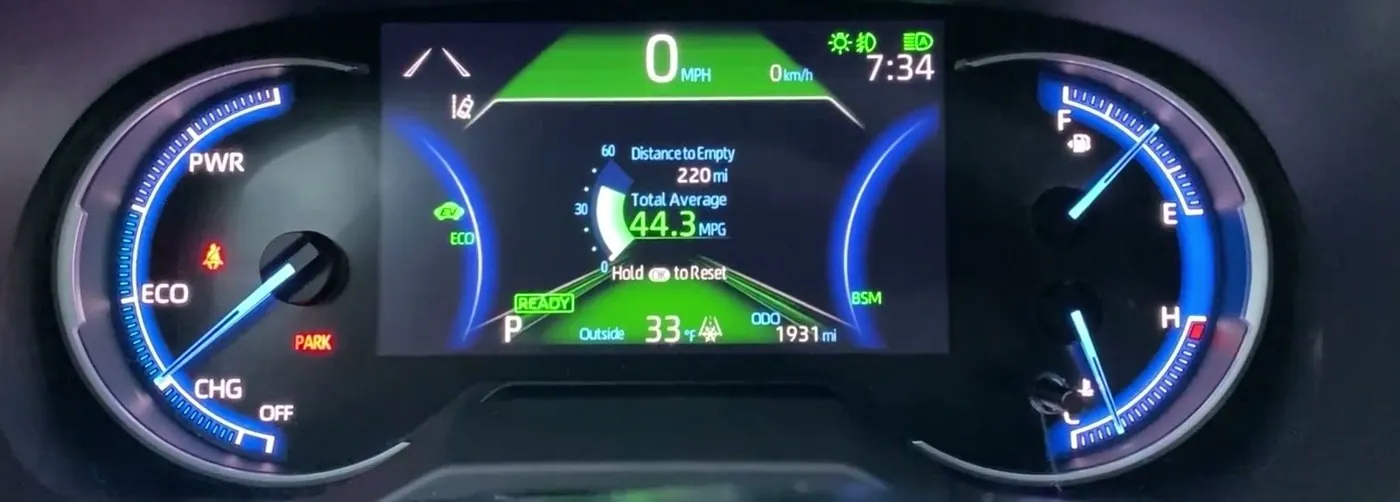
The Hybrid System Indicator on a 2021 RAV4 Hybrid XSE, with the PWR, ECO and CHG areas on the left, from ToyotaJeff Reviews' video.
Basically, the RAV4 Hybrid's push from a stop comes first from its front electric motor, which runs on the hybrid battery (hybrid manual, p.70). An electric motor gives its full pull from zero rpm, or revolutions per minute, so the motor doesn't have to rev up first. And the motor doesn't breathe air, so that push feels the same in Denver as at sea level, as long as the hybrid battery has charge.
But the gas RAV4 has less to give at every speed up high. The gas RAV4's engine already pulls hardest way up at 5,000 rpm. So at altitude, the gas RAV4 needs even more pedal, and the gas RAV4's 8-speed automatic shifts down sooner.
My guide to how the gas RAV4 and RAV4 Hybrid drive explains why the gas RAV4 feels flat at low revs in more detail.
A Colorado AvidGolfer review of the 2018 RAV4 Hybrid, the older generation sold before the 2019 redesign, came to the same conclusion. The reviewer wrote that the electric motor's extra push "isn't affected by altitude," and that the RAV4 Hybrid "handles trips over high mountain passes more adroitly."
So that's one reviewer and an older RAV4 Hybrid, but the same electric push from a stop applies to the 2019 to 2025 RAV4 Hybrid too.
Long climbs: the RAV4 Hybrid's battery can run low
Now here's the RAV4 Hybrid's catch up high. The hybrid battery is small, and on a long, steady climb the electric motors keep drawing from the hybrid battery. So near the top of a long mountain grade, the hybrid battery can run low.
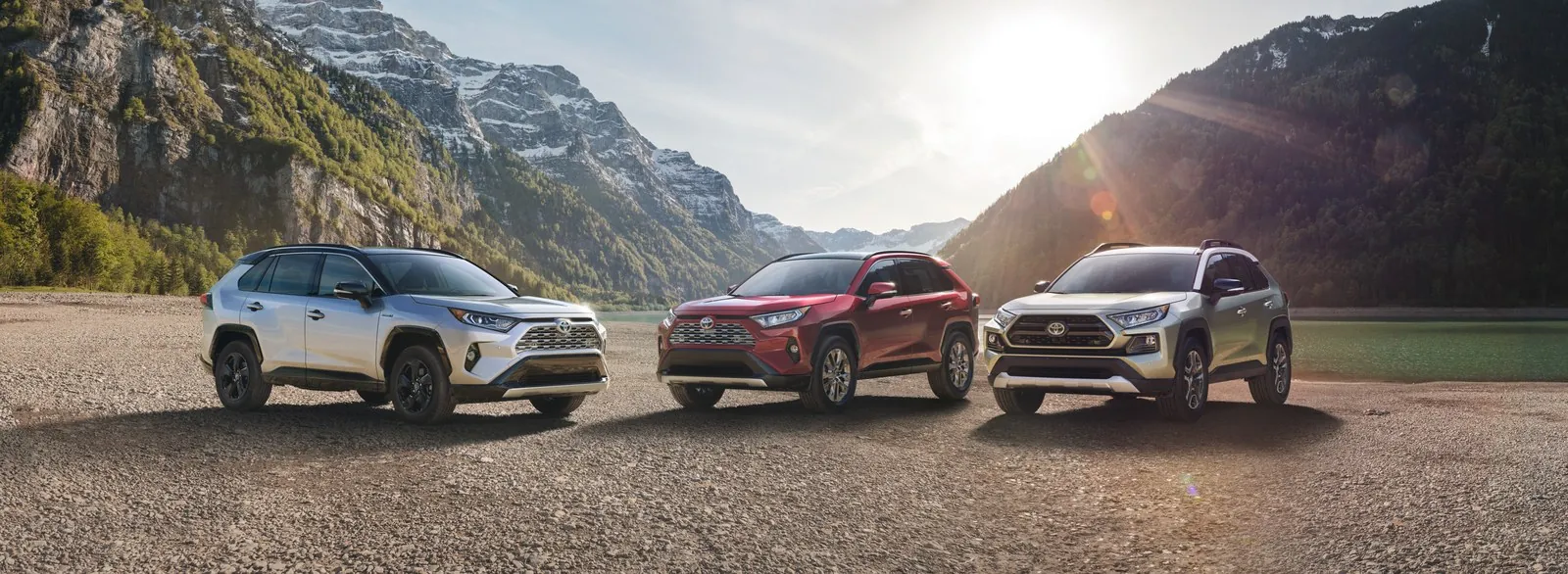
Three 2019 RAV4s parked below high mountains, from Toyota's 2019 RAV4 press photos.
And once the hybrid battery is low, the RAV4 Hybrid is mostly running on its engine. Some owners of Toyota hybrids report their hybrids feeling weaker around 9,000 feet. Those owners also say their hybrid batteries ran down on long climbs, so their hybrids ran mostly on the engine.
So on a long climb in the RAV4 Hybrid, expect the RAV4 Hybrid's engine to run more and rev higher near the top. Something to note is that by my rough math, the RAV4 Hybrid's engine on its own makes about 126 to 128 horsepower at 9,000 feet. That's less than the gas RAV4's 145 to 148 horsepower.
So ultimately, by my rough math, the RAV4 Hybrid is stronger until its hybrid battery runs low. And the gas RAV4 is steadier on a very long, high climb, because the gas RAV4 never had electric help to lose.
Long descents: use S mode in either RAV4
Now going down a long mountain grade is where both RAV4s need a little help from you. Basically, engine braking means the engine and transmission hold the RAV4 back, so the brake pads don't do all the work.
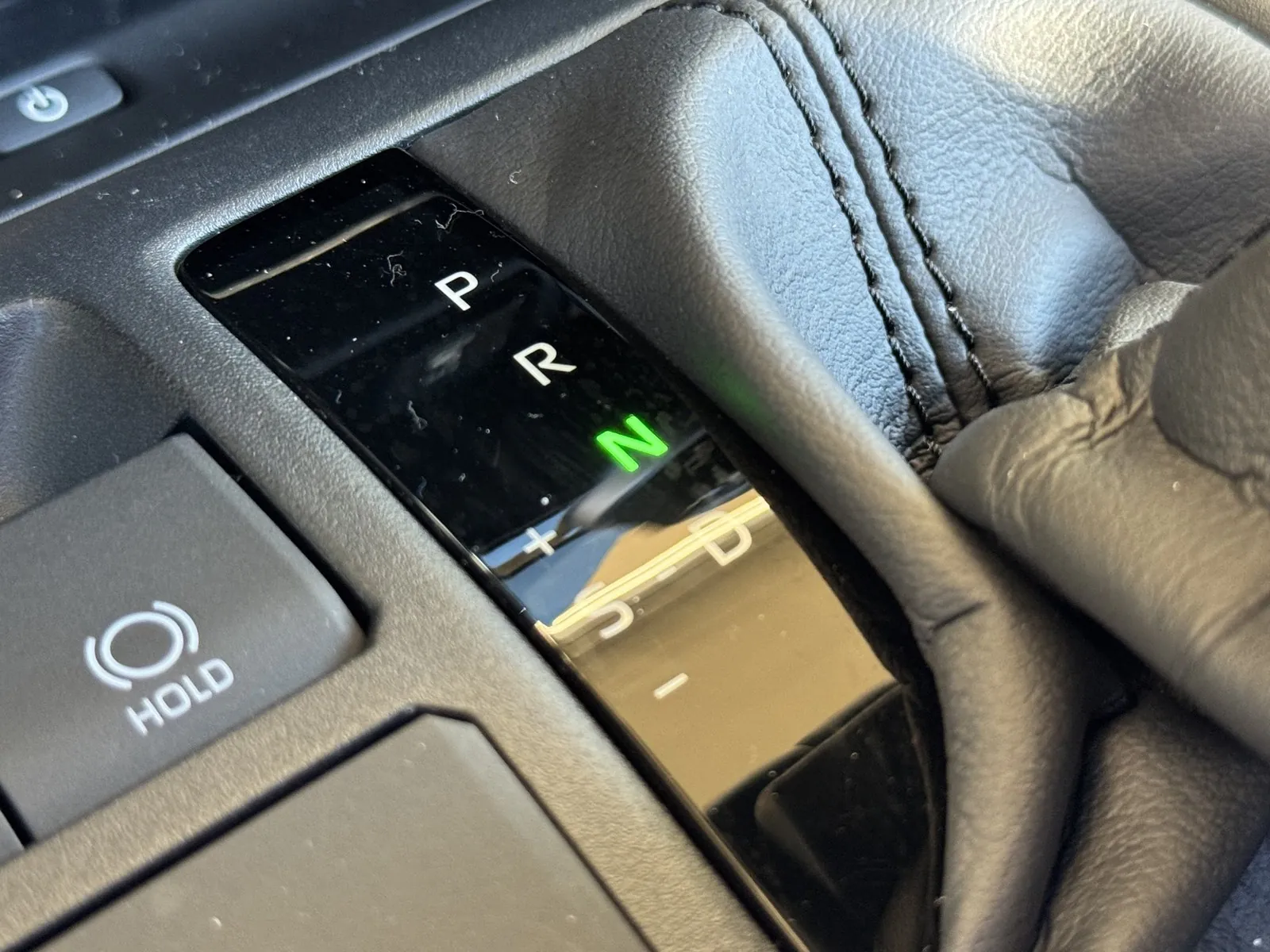
The shift lever on my 2025 RAV4 Hybrid XSE, with the S position and the plus and minus marks next to D.
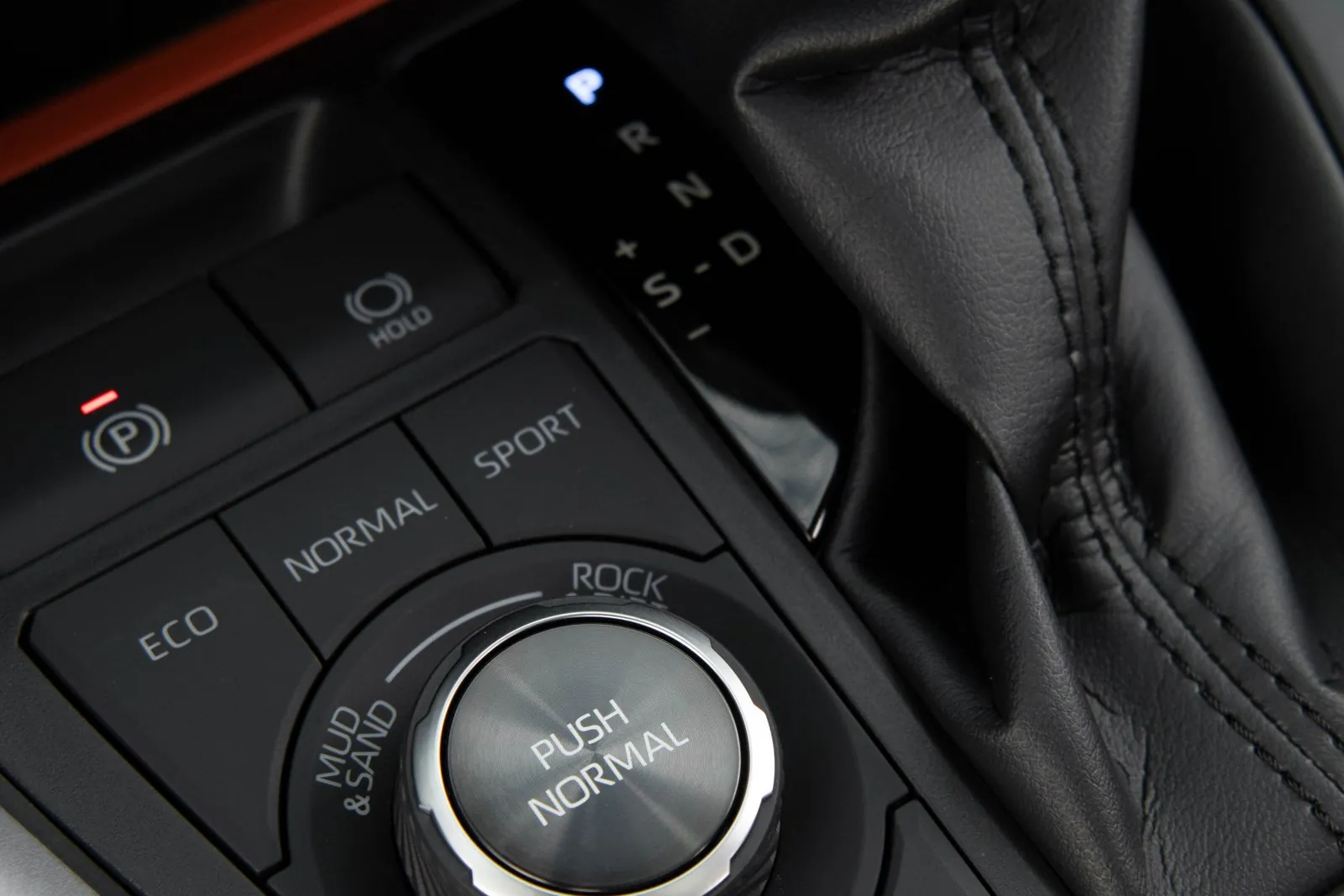
The shift gate on a 2019 gas RAV4 Adventure, with S next to D and the plus and minus marks for changing ranges, from Toyota's 2019 RAV4 press photos.
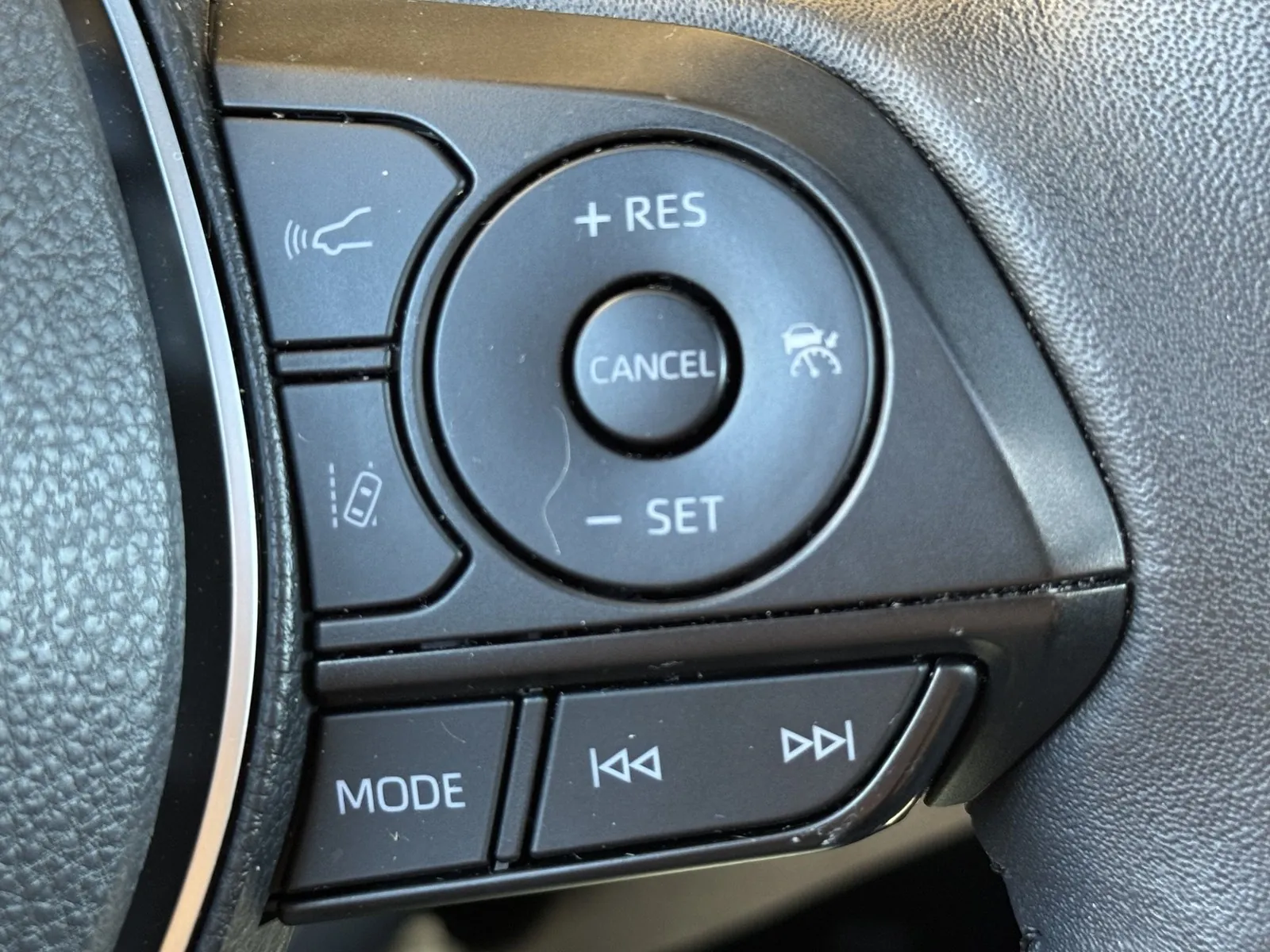
The cruise control buttons on the steering wheel of my 2025 RAV4 Hybrid XSE, with CANCEL in the middle.
Both owner's manuals say to use engine braking by downshifting to keep a safe speed going down a steep hill. And both manuals warn that riding the brakes the whole way down can overheat the brakes, so the brakes work less well. That's in the 2023 to 2025 gas RAV4 manual on p.181, and the 2023 to 2025 RAV4 Hybrid manual on p.197.
So on both RAV4s, you get more engine braking with S mode, which is a manual setting on the shift lever. Here's how to use S mode on either RAV4:
- Move the shift lever from D into the S position next to D. The display shows S and a number, like S4.
- Pull the shift lever back toward you to drop to a lower range, and push the shift lever forward to go back up. A lower range gives more engine braking, and the engine revs higher.
- Shift the lever back to D once you're off the long grade.
Something to note is that the two RAV4s have a different number of ranges. On the 2023 to 2025 gas RAV4, S mode goes from S1 to S8 (gas manual, p.211). And on the 2023 to 2025 RAV4 Hybrid, S mode goes from S1 to S6 (hybrid manual, p.229).
And the 2019 to 2025 RAV4 Hybrid's shift lever has no B position, so S mode is the setting to use for engine braking.
Basically, dynamic radar cruise control is Toyota's cruise control that keeps a set gap to the car ahead. If dynamic radar cruise control is on, downshifting in S mode won't add engine braking (gas manual, p.209, and hybrid manual, p.226). So I'd turn off cruise control before a long descent.
And sometimes either RAV4 won't allow a downshift, and the buzzer beeps twice (gas manual, p.212, and hybrid manual, p.229). If that happens, brake a little to slow down, then try the downshift again.
Now the RAV4 Hybrid has one more reason to use S mode on a long descent. Basically, when you lift off the gas, the RAV4 Hybrid's motor slows the RAV4 Hybrid and charges the hybrid battery. That's called regenerative braking.
But regenerative braking needs room in the hybrid battery, and on a long descent the hybrid battery can fill up. So once the hybrid battery is full, more of the slowing falls to the engine and the brakes.
And something to note is that some 2023 to 2025 RAV4 Hybrids have a feature called Predictive efficient drive. When the navigation shows a long downhill on your route, the RAV4 Hybrid lowers the hybrid battery's charge before the slope. That leaves room to charge on the way down (hybrid manual, pp.73 to 74).
So to use Predictive efficient drive in the mainland U.S., turn on the navigation's route guidance.
And if you tow with the RAV4 Hybrid, the hybrid manual says to slow down and downshift before a steep or long downhill. And when you want engine braking while towing, use S mode, not D (p.213). My RAV4 towing guide covers how much each RAV4 can tow.
The gas RAV4's Stop and Start may not work up high
And then regarding Stop and Start, it's a feature on some gas RAV4s that shuts the gas RAV4's engine off at a stoplight to save gas. The engine starts again when you lift off the brake.
Up high, the gas RAV4's Stop and Start may not shut the engine off at all (gas manual, p.306). And the display may show "In Preparation" when you're driving in a high altitude area (p.308).
Basically, the gas RAV4 idling at stoplights up high is normal, not a fault. So there's nothing you need to fix. The RAV4 Hybrid doesn't use Stop and Start, because the RAV4 Hybrid's engine already shuts off on its own when the RAV4 Hybrid stops (hybrid manual, p.70).
Which RAV4 makes more sense if you live up high
So if you live at elevation, the RAV4 Hybrid has a real edge. The RAV4 Hybrid loses a smaller share of its power, and its push from a stop stays the same while the hybrid battery has charge. You'll notice the RAV4 Hybrid's edge most when pulling away from stoplights and merging.
But if you do a lot of long, steep mountain climbs, keep in mind that the RAV4 Hybrid's battery help can run out near the top. And if you tow, the gas RAV4 Adventure (2019 to 2024) and gas RAV4 TRD Off-Road (2020 to 2024) are rated for 3,500 pounds.
Other 2019 to 2025 gas RAV4s tow 1,500 pounds, and the 2019 to 2025 RAV4 Hybrid tows 1,750. But otherwise, if you live up high, the RAV4 Hybrid is the one I'd pick.
My main guide to the RAV4 Hybrid vs gas RAV4 goes through towing, mpg, price and the rest.
Buddy's take
So ultimately, if you live up high, I'd pick the RAV4 Hybrid. Thin air takes power from both RAV4 engines, but the RAV4 Hybrid's electric push from a stop stays the same while the hybrid battery has charge. And that's the part of the drive you feel most every day.
But on long mountain grades, either RAV4 does better with a little help from you. Expect the RAV4 Hybrid's engine to work harder near the top of a long climb. And on the way down, put either RAV4 in S mode and turn off cruise control, so the brakes stay cool.
So hopefully this helps you figure out which RAV4 fits where you drive. And if you have a question, feel free to email me at contact@ravbuddy.com. I read as many messages as I can, and your questions help me improve these guides.
Have a question about “RAV4 at high altitude: does elevation hurt the gas RAV4 or the RAV4 Hybrid more?”?
Ask it here. Every question comes to me first. I answer as many as I can, and each answered question goes on this page with my answer so other RAV4 owners can see it too. I don't ask for your email, so check back on this page for the answer.
More buying guides
Is a dealer markup on a 2026 RAV4 worth paying? What you should actually pay
I go through what the 2026 RAV4 Hybrid and RAV4 Plug-in Hybrid should cost by trim, including the out-the-door price with tax and fees, what buyers are really paying, and how markups differ from dealer add-ons. And I lay out how to get a fair price, step by step.
2026 RAV4 problems so far: the recalls, Toyota bulletins and owner complaints
Is the 2026 RAV4 reliable, or should you wait? I go through every 2026 RAV4 Hybrid and Plug-in Hybrid recall, the Toyota bulletins and their workarounds, and what owners are actually reporting.
2026 RAV4 trims: prices, what each adds, and the best value
Every 2026 RAV4 Hybrid and Plug-in Hybrid trim, from the LE to the GR SPORT, with prices, packages and which one makes sense for you.
2026 RAV4 vs 2025 RAV4: should you wait for the new one or grab a leftover 2025?
I compare the 2025 RAV4 and the all-new 2026 RAV4 trim by trim. That covers what changed, what each year costs and what the 2026 gives up. It also covers how hard each year is to find and the early 2026 recalls.
Best RAV4 trim for families: rear USB ports, washable seats, heated back seats and kid-proofing
The family features that change from trim to trim on every 2019 to 2026 RAV4, gas, Hybrid and Prime, plus how to use the child locks and window lock, and which sunshades, kick mats and seat protectors to get.
2026 RAV4 Hybrid vs RAV4 Plug-in Hybrid vs the electric Toyota bZ
I compare the prices, mileage, charging, running costs, towing, cargo and reliability of the 2026 RAV4 Hybrid, the 2026 RAV4 Plug-in Hybrid and the fully electric Toyota bZ. And I lay out the pros and cons of each one so you can pick.
RAV4 Hybrid vs RAV4 Prime vs bZ4X: which one makes sense for you (2019 to 2025)
The 2019 to 2025 RAV4 Hybrid never plugs in, the RAV4 Prime plugs in for about 42 miles of electric driving, and Toyota's bZ4X runs on electricity only. Here's what each one costs to buy and run, and who each one suits.
2019 RAV4 hesitation and lurching: is the 2019 a bad year, and did Toyota fix it?
The gas 2019 RAV4 can hesitate and then lurch forward when you speed up from a slow roll. Here's exactly when the lurch happens, which RAV4s have it, Toyota's free fix, and how to check a used 2019 has the update.
How RAV4 AWD works, and is the Hybrid's AWD real AWD?
The RAV4 has used three different AWD systems since 2019. Here's how each one works, when the rear wheels actually get power, and what that means for you.
Is the RAV4 easy to get in and out of? Seat height, headroom and long-drive comfort, by year
Which RAV4 front passenger seats raise and lower, how high a RAV4 sits next to a CR-V, Corolla Cross and Forester, how much headroom a moonroof costs, and what Toyota says about grab handles and seat cushions.
Is the RAV4 big enough for a family of 4 or 5? Cargo, strollers and car seats by year
Real suitcase and stroller tests, back seat room and loading limits for every RAV4 from 2019 to 2026, plus the situations where a family needs something bigger than a RAV4.
How long does a RAV4 Hybrid battery last? What to know before buying one with 100,000+ miles
Which hybrid battery each 2019 to 2026 RAV4 Hybrid and RAV4 Prime has, how long Toyota's battery warranty lasts and whether it moves to the next owner, what a new battery costs, and the checks to do on a used RAV4 Hybrid before you buy it.
RAV4 Hybrid vs Corolla Cross Hybrid: is the bigger Toyota worth the extra money?
The 2026 RAV4 Hybrid against the 2026 and 2027 Corolla Cross Hybrid, plus the used 2019 to 2025 RAV4 Hybrid against the 2023 to 2025 Corolla Cross Hybrid.
RAV4 Hybrid vs CR-V Hybrid: which one should you buy?
The 2026 RAV4 Hybrid against the 2026 and 2027 CR-V Hybrid, plus the used 2019 to 2025 RAV4 Hybrid against the 2020 to 2025 CR-V Hybrid. Price, real mpg, back seat room, car seats, safety, and the problems to check on each one.
Is the RAV4 Hybrid worth it, or should you just get the gas RAV4?
The 2019 to 2025 RAV4 came with a gas engine or as a hybrid, and every 2026 RAV4 is a hybrid or plug-in hybrid. Here's what the RAV4 Hybrid costs extra, how fast the fuel savings pay that back at your miles, and how reliable the gas RAV4 and the RAV4 Hybrid are.
RAV4 Hybrid vs Tucson Hybrid vs Sportage Hybrid: is the Toyota still the best?
The 2026 RAV4 Hybrid against the 2026 Hyundai Tucson Hybrid and 2027 Kia Sportage Hybrid. Price, real mpg, car seats, safety, warranty, which one you can buy without a markup, and what to check used.
Is the RAV4 good in snow? Gas AWD vs Hybrid AWD vs FWD
Will a RAV4 get you up an icy driveway, is the Hybrid's AWD real AWD, and do you need winter tires? Here's the honest answer for every RAV4 from 2019 to 2026.
What a RAV4 costs to insure and own, and how worried to be about theft
What full coverage on a RAV4 costs by powertrain, what a RAV4 Hybrid costs to own each year, how RAV4 theft rates compare with the CR-V, and whether a catalytic converter shield is worth it.
Should you lease or buy a RAV4? The math on Toyota's 2026 offers, and what to do when a RAV4 lease ends
I go through what Toyota's October 2026 RAV4 Hybrid lease really costs, how it compares with buying over 3 and 5 years, and how Toyota's loan rates stack up against a credit union. And if your RAV4 lease is ending, I cover buying it out, returning it and what Toyota charges for wear.
Is the RAV4 good off road? How far each RAV4 goes, and what Trail mode really does
Can a RAV4 handle forest roads and mild trails, or do you need a 4Runner? Here's how far every 2019 to 2026 RAV4 really goes, and which buttons your RAV4 has.
RAV4 Prime and Plug-in Hybrid electric range: will it cover my commute, even in winter?
Real electric range for the 2021 to 2025 RAV4 Prime and the 2026 RAV4 Plug-in Hybrid by season and speed, a simple way to check your commute, and why the gas engine starts on cold days.
RAV4 Plug-in Hybrid vs Tesla Model Y, Outlander PHEV and Tucson Plug-in Hybrid: which costs least to own?
The 2026 RAV4 Plug-in Hybrid and the 2021 to 2025 RAV4 Prime against the Tesla Model Y, Mitsubishi Outlander PHEV, Hyundai Tucson Plug-in Hybrid and Toyota bZ. Five-year cost, electric range, charging, road trips, resale and room.
Is the RAV4 really as reliable as its reputation, and is it still the best compact SUV?
The 2019 to 2026 RAV4, gas, Hybrid, Prime and Plug-in Hybrid, against the CR-V, Forester, Tucson, Sportage, CX-5 and CX-50. Owner complaints per car sold, what each reliability source says, the 2026 question, and where the RAV4 ranks right now.
Is the RAV4 Hybrid a good car for Uber, Lyft and DoorDash?
Here's what a RAV4 Hybrid costs per mile when you drive 40,000 miles a year for Uber, Lyft or DoorDash. And here's which ride types the RAV4 Hybrid qualifies for, what wears out, and whether the electric bZ is cheaper.
Is the RAV4 good for road trips? Range, highway mpg and how to pack it
How far each RAV4 goes on a tank at highway speed, what a roof box really costs you, whether the hitch carrier is the better pick, how to fit kids and a dog, and how road trips work in a RAV4 Prime or Plug-in Hybrid.
Does a RAV4 fit three car seats across? Results by year, and what to buy if you need three car seats
What certified car seat technicians found in every RAV4 from 2019 to 2026. It also covers the narrow car seats that can fit three across, how the RAV4's car seat anchors work, and which vehicles fit three car seats instead.
How much can a RAV4 tow? Every 2019 to 2026 RAV4, and which campers fit
Can a RAV4 tow a camper, and how much can your RAV4 really tow? Here's the towing rating for every gas RAV4, Hybrid, Prime and 2026 Plug-in Hybrid, plus Toyota's rules and the weight math.
What's my RAV4 worth? Trade-in vs private sale, and trading up to a 2026
I go over what a 2019 to 2025 RAV4 is worth right now, by year and trim, for the gas RAV4, the RAV4 Hybrid and the RAV4 Prime. Then I cover how much more you get selling it yourself, and why a Prime owner should get a CarMax offer first. And I run the numbers on trading up to a 2026.
RAV4 vs Subaru Forester: which one is better in snow, and overall?
The 2019 to 2026 RAV4 gas, Hybrid and Plug-in against the 2019 to 2027 Forester, Forester Hybrid and Forester Wilderness. How the AWD works, what the snow tests showed, and everything else that decides it.
RAV4 vs Highlander vs a minivan: when does a family outgrow a RAV4?
The 2026 RAV4 Hybrid against the 2026 Highlander Hybrid, Grand Highlander Hybrid and Sienna. Who fits, how many car seats, how much luggage, what each one costs, and what changes if you're going the other way, from a Highlander down to a RAV4.
RAV4 Hybrid vs Lexus NX: is the Lexus worth the extra money?
The 2026 RAV4 Hybrid against the 2026 Lexus NX 350h, which shares the RAV4's platform and hybrid engine. Plus used 2019 to 2025 years, the NX 450h+ against the RAV4 plug-ins, and what the 2027 NX changes.
RAV4 vs Mazda CX-5 and CX-50: which one should you buy?
The 2026 RAV4 Hybrid against the all-new 2026 Mazda CX-5 and the CX-50 Hybrid, plus the used 2019 to 2025 RAV4 against the used 2019 to 2025 CX-5 and 2023 to 2025 CX-50. Price, real mpg, room, safety, resale and the problems to check.
RAV4 vs Subaru Outback and Crosstrek: which rides softer and is easier to get in and out of?
The 2019 to 2026 RAV4 gas, Hybrid and Plug-in against the 2019 to 2026 Outback and the 2019 to 2027 Crosstrek and Crosstrek Hybrid. Ride comfort, getting in and out, AWD, price and gas mileage.
Is the RAV4 Woodland, TRD Off-Road or Adventure worth it, or should you just put all-terrain tires on an XLE?
The answer for each year from 2019 to 2026, the price math new and used, what each trail trim really adds, and whether the 2026 Woodland Hybrid or Plug-in Hybrid is the better camping pick.
RAV4 Woodland vs Forester Wilderness vs Bronco Sport Badlands: which is best for camping and dirt roads?
The 2026 RAV4 Hybrid and Plug-in Hybrid Woodland against the Forester Wilderness, the Bronco Sport Badlands and Toyota's electric bZ Woodland. What each one is good at, where each one struggles, and who should pick which.
RAV4 years to avoid: which 2019 to 2025 RAV4s are safe to buy used
The "years to avoid" lists online don't agree with each other. So here's what each 2019 to 2025 RAV4, RAV4 Hybrid and RAV4 Prime year actually had wrong, and which free Toyota fixes to check on the car's VIN. And I cover what's known about the 2026 so far.
The RAV4 Technology Package, explained
What the Technology Package adds on every 2019 to 2025 trim, what it costs, and how each feature works in real life. You'll also see which XSE gets the 12.3-inch gauge screen and where those features went on the 2026 RAV4.
Is Toyota's extended warranty worth it on a RAV4? What Platinum covers, and what it doesn't
I go through what Toyota already covers for free, what the paid plans add, what owners report paying, and how to cancel one you regret.
Toyota Safety Sense on the RAV4: which safety features each year has, and what every alert does
Shopping years and wondering which safety features each RAV4 has? Here's Toyota Safety Sense 2.0, 2.5 and 4.0 by year and powertrain, what each feature does for you, and where to turn the alerts up, down or off.
Every RAV4 Hybrid trim, compared
Here's every RAV4 Hybrid trim from the LE to the Limited, year by year. And it shows what's standard and what you'd pay extra for.
Is a used RAV4 worth it in 2026? How to buy a used RAV4 Hybrid, gas RAV4 or Prime
I go through why used RAV4 Hybrids cost almost as much as a new 2026, the real five-year cost of used vs new, what a high-mileage Hybrid or a used Prime should cost, and whether Toyota Certified is worth paying extra for.
The RAV4 Weather Package, explained
What the Weather Package adds on every 2019 to 2026 trim, what it costs, how each feature works in real life, and who should get it.

What fits in a RAV4? A queen mattress, a 65-inch TV, bikes, furniture and wheelchairs
The measurements that decide whether something fits in a 2019 to 2026 RAV4, then item by item: mattresses, TVs, bikes, furniture and mobility gear.
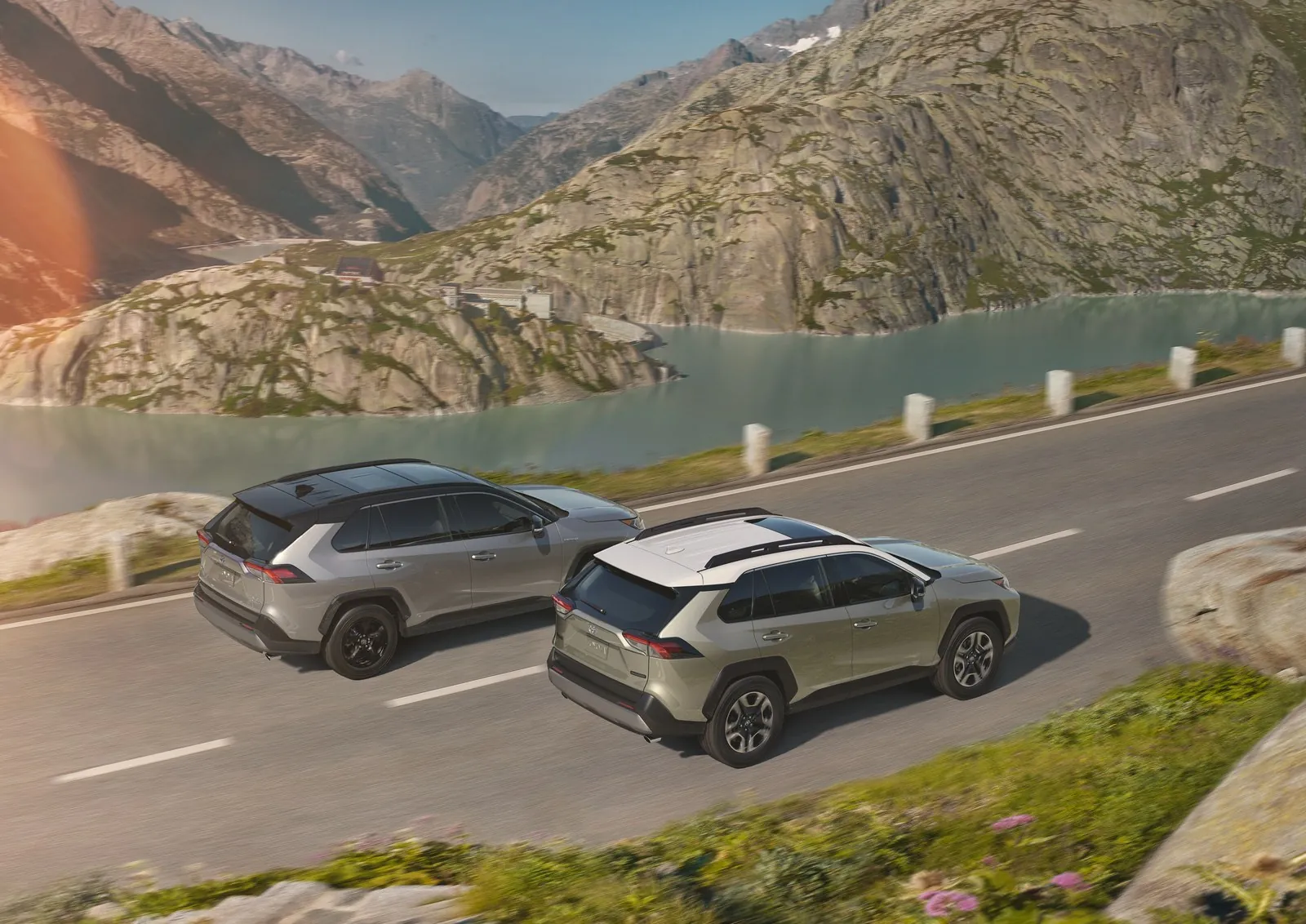
- Top photo: A 2019 RAV4 Hybrid XSE and a 2019 gas RAV4 Adventure on a mountain pass road, from Toyota's 2019 RAV4 press photos.
- Power loss at elevation: Garrett Motion, "How to turbocharge at elevation" (August 15, 2019), for the 3 percent per 1,000 feet rule and turbo engines. The horsepower numbers at Bend, Denver and 9,000 feet are my own rough estimate: the low number in each range comes from standard air pressure at that elevation, and the high number from the 3 percent rule. No measured RAV4 altitude test has been published.
- Toyota owner's manuals: 2023 to 2025 gas RAV4 (OM0R100U), pp.181, 209, 211, 212, 306 and 308, and 2023 to 2025 RAV4 Hybrid (OM0R102U), pp.70, 73 to 74, 197, 213, 226 and 229.
- Review: Colorado AvidGolfer, 2018 RAV4 Hybrid SE AWD review (May 23, 2018, the generation before 2019). Towing ratings from my RAV4 towing guide.
- 2026 RAV4 power: Toyota newsroom, October 22, 2025.
RAV Buddy is an independent fan site. We're not affiliated with or endorsed by Toyota. RAV4 is a trademark of Toyota Motor Corporation.